La Bocca della verità
This site is dedicated to the legendary medallion located in Rome under the front portico of the church of Santa Maria in Cosmedin (41.8882,12.4814). If you want to learn more about its history and what it really is, keep reading. You've come to the right place.
Who I am and why I created this site
My name is Massimo Portolani. I got to know about the Mouth of Truth in 1987
and since then it has become part of my life, because I started producing machines with the face
of the Mouth of Truth, and little by little, I began to become interested in its history.
If you are interested in the history of the Mouth of Truth, read on.
If you are interested in the machines we produce, you can go directly to those at the bottom of this page.
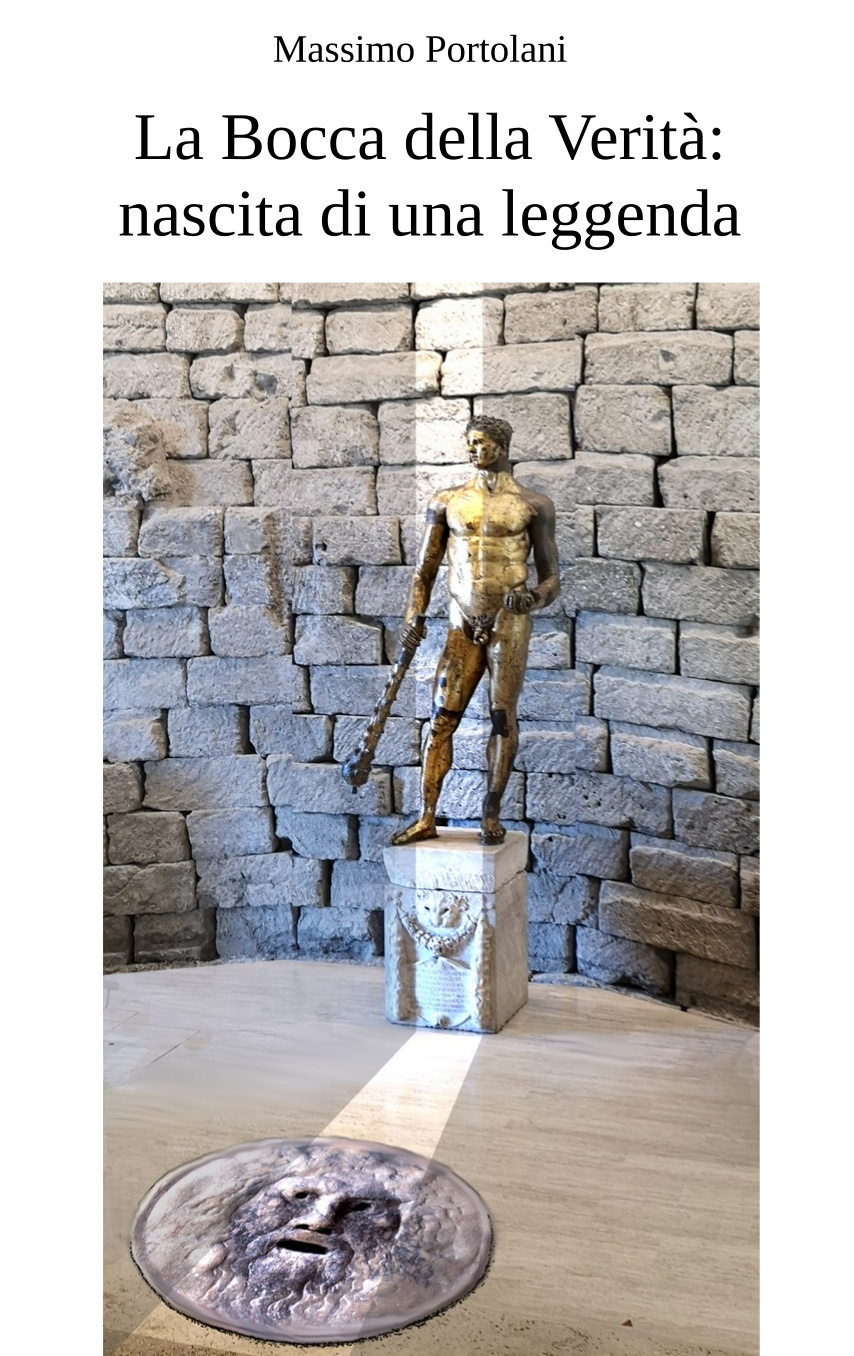
In the following lines, I'll provide basic information about what it is and also formulate a hypothesis, based on facts and reasoning, about what it really was. If you'd like more information, you can read it in my book. "La Bocca della Verità: nascita di una leggenda" soon to be available on Amazon.
Why is the mouth of truth so famous?
Over the years, the Mouth of Truth has become one of Rome's most visited monuments, and this is undoubtedly due
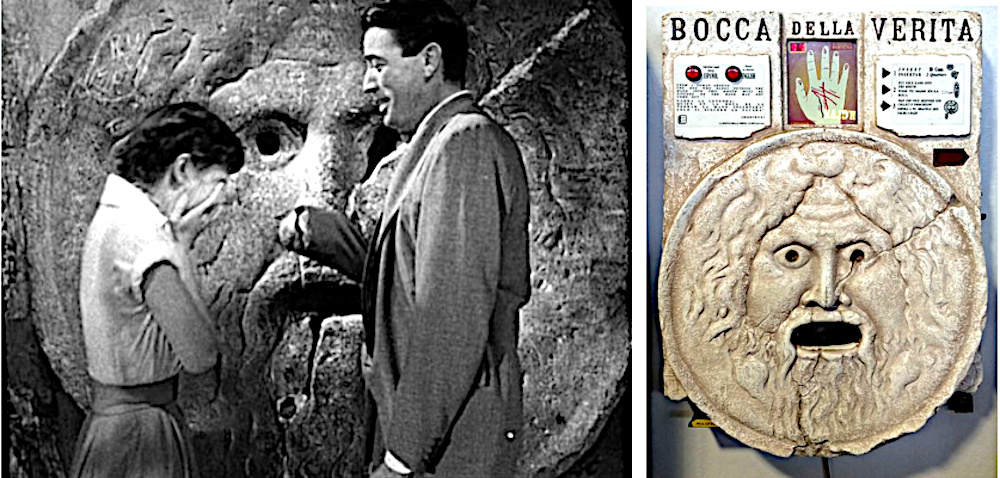
to the 1953 film Roman Holiday, starring Audrey Hepburn and Gregory Peck, with the famous scene in
which he pretends the Mouth has eaten his hand. When I first became interested in it, in 1987,
when I built the first machine in Rome's Luneur Park, there weren't many people
who went to visit the Mouth, mostly buses full of Japanese. Admission was free, and in the church
they were almost annoyed that people visited this pagan place and didn't also visit
the (beautiful) church. Today, things are completely different; there's a line and you have to pay something.
The last time I went, it was a free offering.
Moreover, as I explain in my book, even during the Renaissance, the Mouth of Truth, which was located
against the exterior wall of the church, served as a tourist attraction for pilgrims and those who came on the grand tour, so it can be said that today the Mouth of Truth has resumed that function successfully.
I also made a small contribution to its success, because I designed and built the Mini Bocca-type machine that can be seen on the Wikipedia site under the entry 'Mouth of Truth',
and I personally brought that one to San Francisco in 1992.
Not to mention the hundreds of machines that ended up in Japan, allowing the Japanese to put their hand in the Mouth of Truth without coming to Rome, as you can see in this video
You can see all the models we have produced and the offers we still have, at the bottom of this page.
Some data relating to the Mouth of Truth
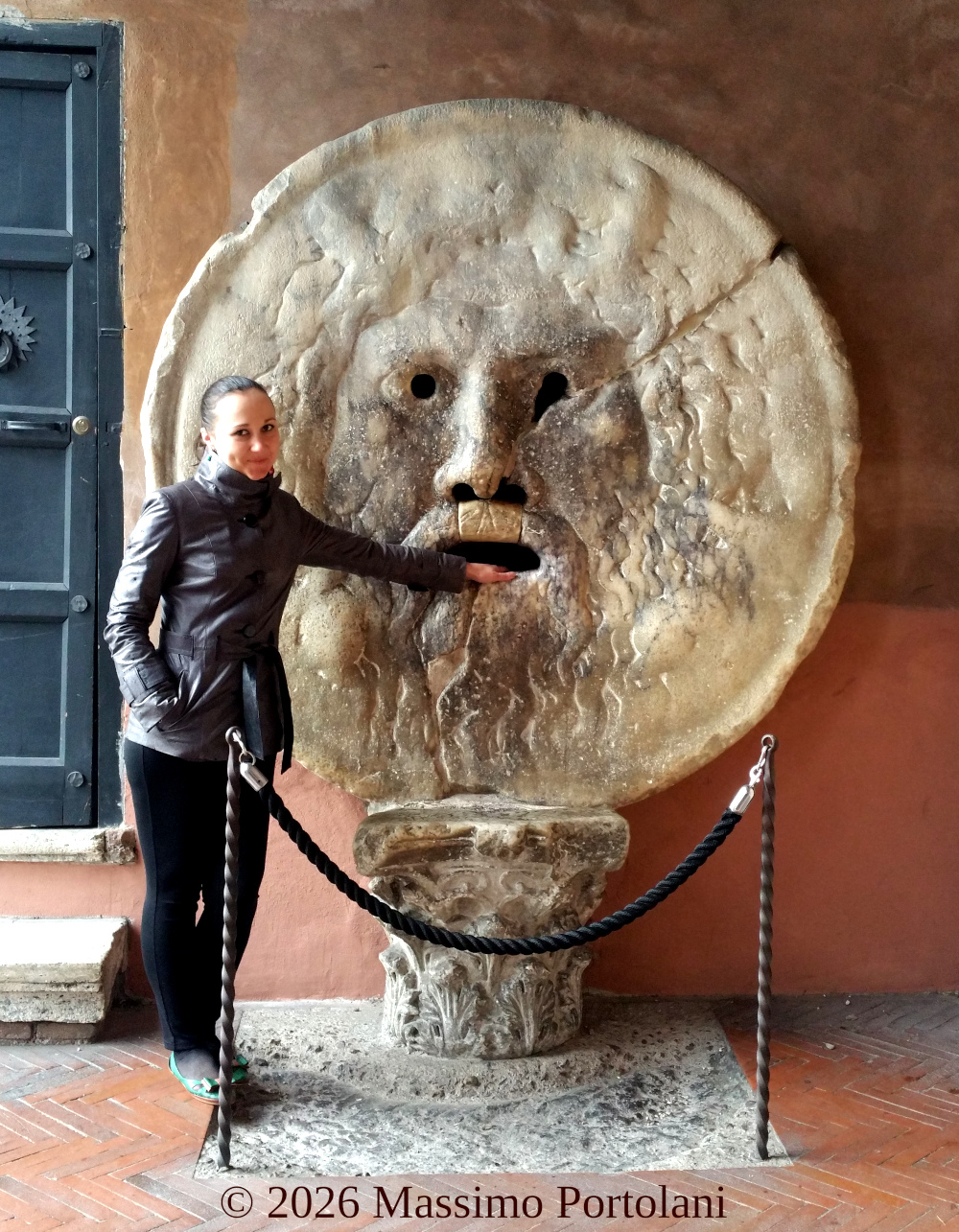
The Mouth of Truth is a medallion in Pavonazzetto marble, and these are some facts about it:
- Diameter: 170 cm
- Weight: about 1230 Kg
- Thickness: 19 cm
- Age: about 1800 years
295
In 1990, Father Elia, the parish priest of the Church of Santa Maria di Cosmedin, told me that this type of marble came from Phrygia. I later discovered that it came from a place called Docimium in Roman times, which today corresponds to İscehisar, in the province of Afyonkarahisar in modern-day Türkiye.
During the Imperial Age, a constant flow of ships brought pre-worked marble from this place,
as well as from others, each famous for its own type of stone.
These semi-manufactured pieces were transported by land and river to Ephesus, and from there they arrived by ship in Rome, at the Marmorata, along the Tiber, where the processing residue was so abundant that it formed part of the Testaccio hill. These consisted of cylinders, that is, rough columns, but also disks like the one in the Mouth of Truth, and other geometric figures. In Iscehisar, Turkey, there are still fields full of this material. I personally visited there a few years ago and met artisans who still work this marble today.
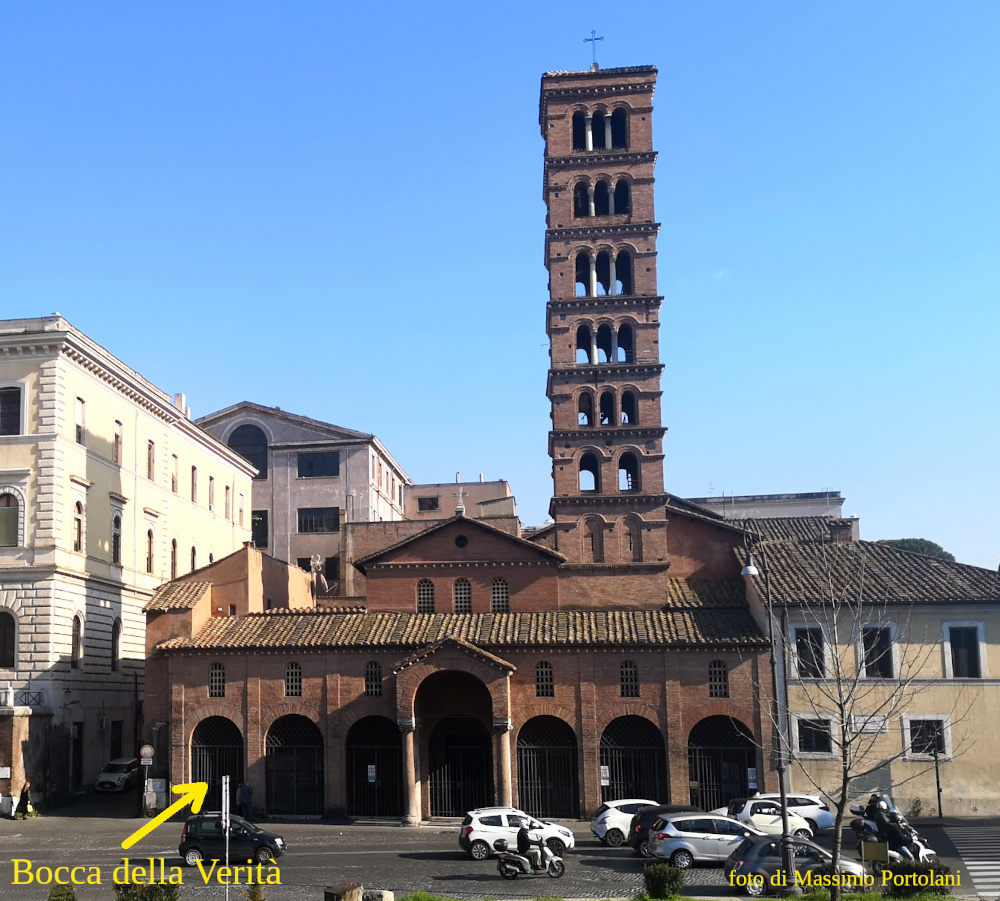
Where is the Mouth of Truth located?
The Mouth of Truth is currently located under the portico of the Melkite Greek-rite basilica of Santa Maria in Cosmedin (41.8882,12.4814), near Tiber Island, in what was once the Forum Boarium, the primary meeting place in ancient Rome, where hilltop inhabitants met to trade. It is also close to where the Cloaca Maxima flows into the Tiber. The Mouth of Truth rested against the church's exterior wall for some time, as evidenced by 16th-century drawings. We know for certain that in 1632, Canon Placidi, rector of the church, had it placed under the portico, where it remains today.
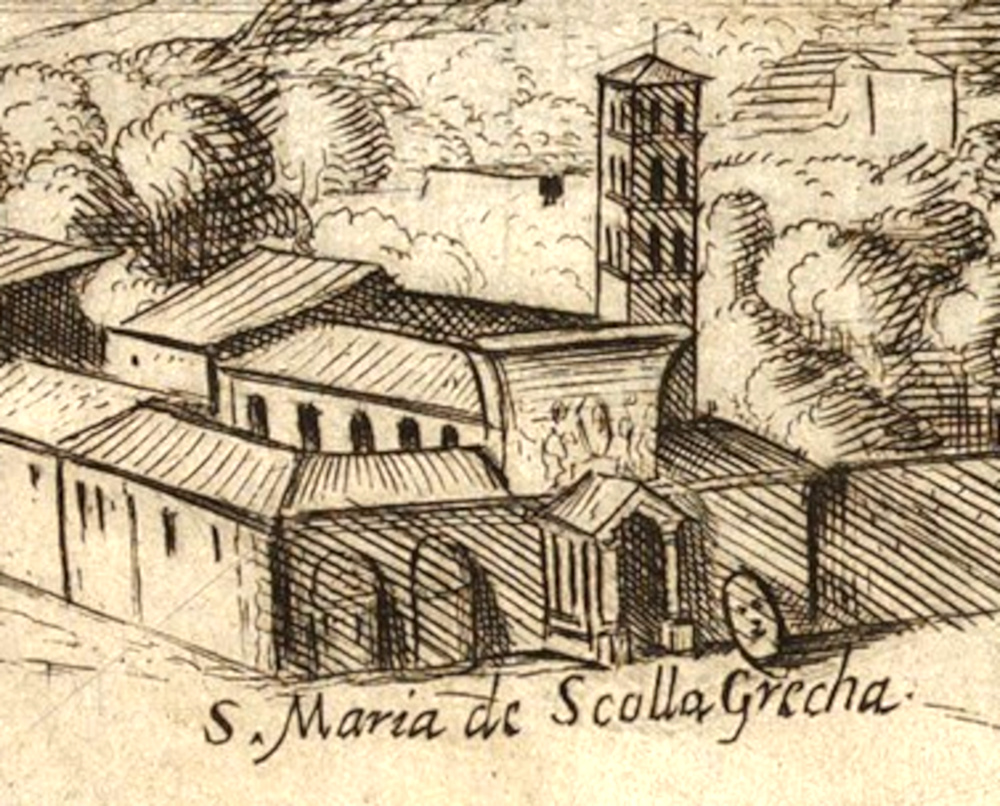
The Mouth of Truth in Antonio Tempesta's map
Antonio Tempesta's 1593 Map of Rome is a monumental map and offers an extraordinary documentation of the city at the time of Pope Clement VIII, with an exceptional level of detail.
In one part of this map, the area of the Forum Boarium is visible, with the Tiber Island and
the Basilica of Santa Maria in Cosmedin, with the Mouth of Truth outside, on the right side.
Giovanni Maria Crescimbeni, canon of the basilica since 1705, wrote a history of the basilica in 1715, which states: "The church of Santa Maria in Cosmedin...is much better known for a nickname given to it by the people, who from time immemorial have called it the Mouth of Truth...the reputation arose from a large round stone in the shape of a medallion, representing the face of a man, which can be seen inside the Portico of the Church, where it was transported by Ottavio Placidi, our canon, in the year 1632, and before that, for many centuries, it had been outside leaning against the wall of the facade of the Portico facing the Marmorata."
Crescimbeni also tells us that the first church was built by Pope St. Dionysius, who held the Holy See from 261 to 272, near a place called the Schola Graeca, and near an altar where swearing was done while making agreements, and which was called the Mouth of Truth, as we still call this place today. The church, still of Greek rite today, stands in the area where the Greeks lived in Rome, and where those arriving went, which was called the Schola Graeca. Nearby stood the Ara Maxima of Hercules; in fact, today we know that part of the tuff base of the Ara Maxima is where the crypt of Santa Maria in Cosmedin was built.
And it continues: "In 772, under the pontificate of Hadrian I, a great multitude of people were employed, who, by force of sword and fire, reduced the place to a square and rebuilt it from the foundations in the large and magnificent form that can be seen...rebuilding our church in the form of a basilica with three naves and adorning and embellishing it in such a way that it was qualified above all the other churches of Rome with the very specious title of Cosmedin, taken from the Greek, which in our language means ornament."
One theory is that the Mouth of Truth was a manhole inside the Altar of Truth and that when this was destroyed in 772, the stone with the face of the Mouth was placed against the facade and remained there until 1632.
Who represents the Mouth of Truth?
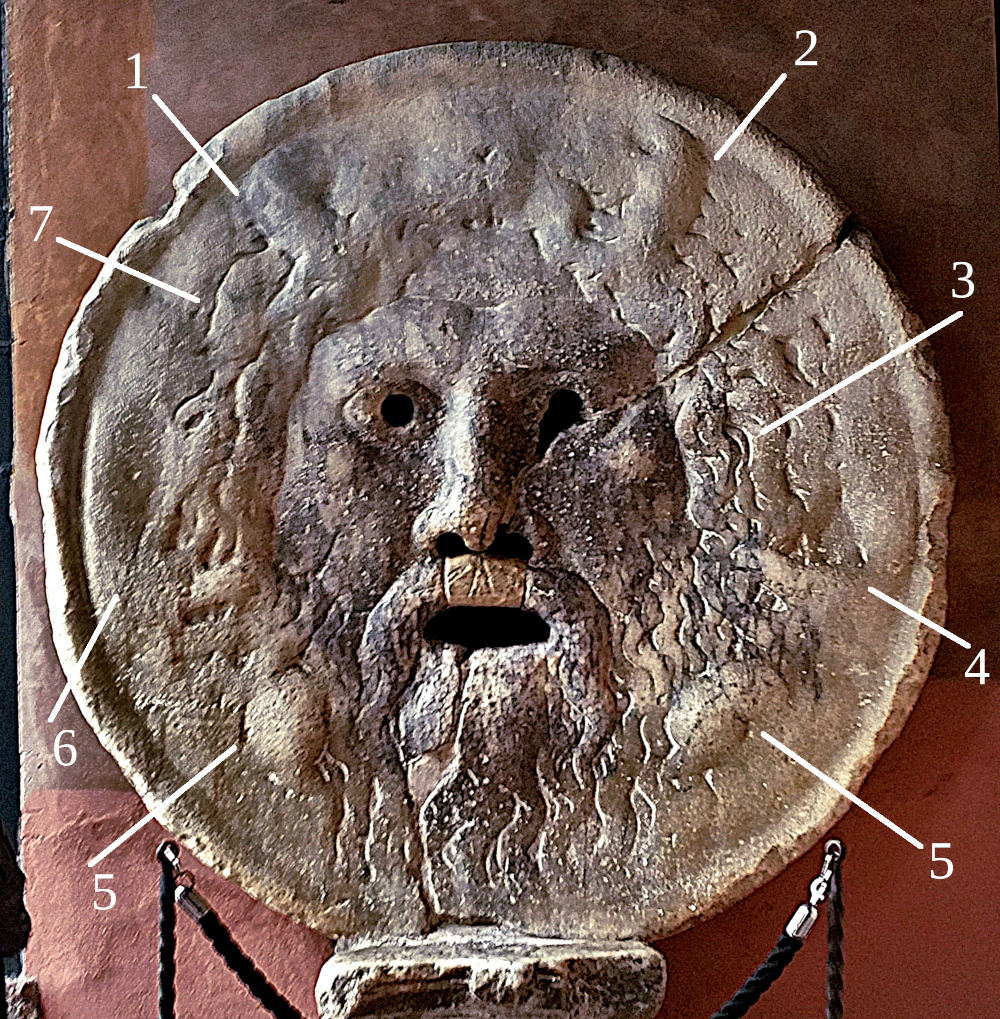
The Mouth of Truth represents Oceanus (Okeanos in Greek), the deity identified with the river that
surrounds the entire earth, essentially the river after the Strait of Gibraltar, which we also call the Pillars of Hercules,
which we still call the Ocean. This is evident from the waves that envelop the face, but especially from the two horns that
are actually crab claws (1, 2), typical of Oceanus; the one on the right is very evident. For example, the same type of claw-like horns are found in the Okeanus
at the Bardo Museum in Tunis or in the Okeanos and Tethys located in Gaziantep, Turkiye.
At the bottom there are also the heads of two dolphins (5), recognisable by their characteristic beak..
Then there are various artificial touches that may have served to tell some story to tourists in past centuries.
For example, some have said that there are two wolf heads (4 and 6). But in reality, it's clear that they were created with small adjustments over time. Then there's a head (3), but it's also clear that it was created with some
sign that modifies the waves. Finally, on the left, there's a roughly carved fish (7). It was probably
made to neutralize the powers of the pagan deity. In fact, the fish represents Christ.
Even the two large teeth marked on the upper lip are a clear allusion to the fact that the Mouth eats hands.
What was the Mouth of Truth used for?
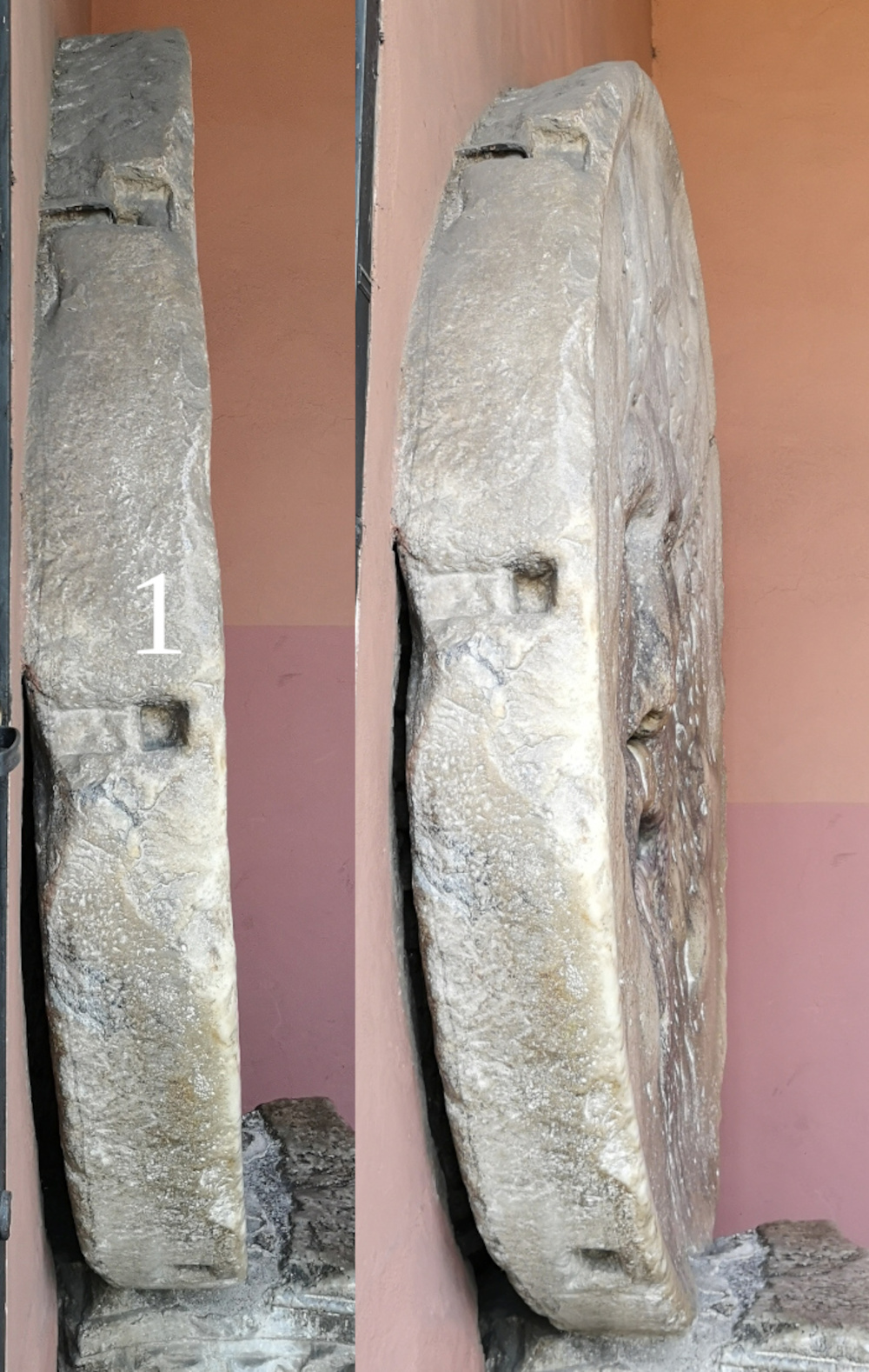
As you can see from these side photos, the Mouth of Truth has no protuberances and the face is sunken, so the water that falls on it ends up in the slits of the eyes, nose, and mouth. For this reason, it has been repeatedly written that it is a manhole cover. And this is also what Crescimbeni, in his history of the basilica, tells us that some "they judge that this stone was really a manhole for rainwater...placed in the square of some temple, or inside one of those many temples, which were open at their top,...like the Pantheon" but he considers it "impossible that this beautiful sculpture was used in such an abject way, such as to be dirtied and trampled on by all the people, regardless of the fact that such trampling would have left marks, which instead are not there" and then evaluates that "it is a divinity esteemed by the pagans, who would not have used it to cover a sewer, he also evaluates the quality of the marble, which is pavonazzetto and therefore very valuable.
The Legend of the Adulterous Woman
Ersilia Caetani Lovatelli (1840-1925), the first woman elected to the National Academy of the Lincei,
wrote an essay on the Mouth of Truth in Nuova Antologia, Rome, 1891, in which, after various considerations,
she concludes that it was a manhole designed to collect rainwater, and tells the story of the adulterous woman. "We also happen to find mention of it in a description of Rome written for the Jubilee of the year 1450, in which we read the following exact words: A round stone like a millstone with a face carved into it, called the stone of truth, which in ancient times had the power to show when a woman had committed an offence against her husband.".
She writes of a tale, written by many other authors: A woman, who was having an illicit affair, when her husband, who had become suspicious, demanded this proof, found a way to frustrate it. She told her lover to dress and behave like a madman and be at the place where the oath was to take place, and as soon as he saw her approach, to run to her and embrace her in a frenzy. And so it was; she pretended to be indignant at the act, but her husband and the bystanders, being a poor madman, paid no attention. Then the woman swore that never in her life had she suffered the embraces of any man other than her husband and that madman whom everyone had seen embracing her. And since this was the pure truth, her hand emerged unharmed from the terrible mouth.
In a German version of the Mirabilia from 1487 we see the Mouth mentioned and also the explanation that Virgil had made it: "zu Vnser Lieben Frawen Scola Greca. Da stet noch der stein, der den leuten die finger abe beys, so sie vnrecht gesworen hetten. Der stein heist vf welsch 'la bucca de la veritade'. Den stein hat Virgilius gemacht. Der stein verlos sin kraft von einer bosen frawen, die betrog den stein.
Further details on Virgil as a necromancer in the Middle Ages and the various texts and legends can be found in the book
by Massimo Portolani, "Bocca della Verità: nascita di una leggenda," soon to be available on Amazon.
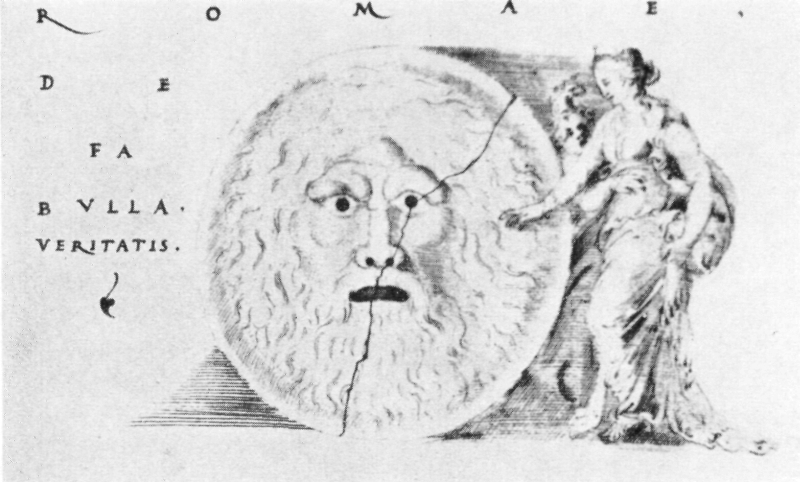
In the drawing by Francisco de Hollanda from 1538/1539, we see the Mouth of Truth still on the ground, and not raised as it is now.
This shouldn't surprise us, because the painter
drew it—in excellent detail—60 years before Tempesta's 1593 print, where it is seen leaning against the wall.
Note how sharp the break was.
Hercules, the most famous demigod of antiquity
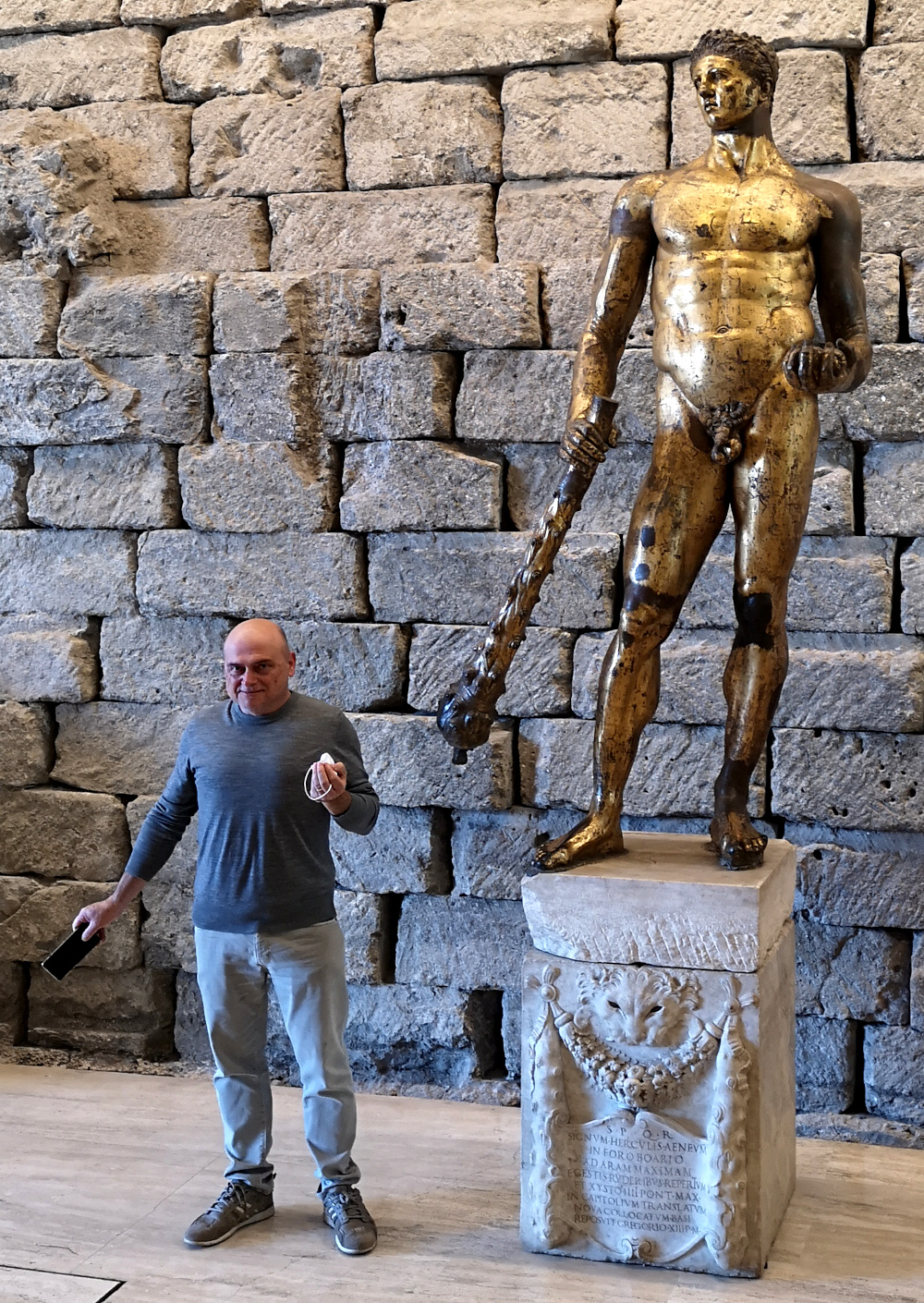
In the Capitoline Museum in Rome there is a gilded statue of Hercules, which was found around 1470, when
the temple dedicated to Hercules built by Aemilianus was destroyed during the reign of Pope Sixtus IV.
The photo alongside shows this statue with me beside it, equipped with the tools of modern man: a telephone
instead of a club and a mask (this was the time of COVID) instead of the apple of eternal life.
The Romans swore, but also cursed, saying Mehercule! that is, By Hercules!
The full phrase is: "Ita me Hercules Jovet!", meaning: So help me, Hercules.
Hercules, Herakles in Greek, was the quintessential Greek hero, never defeated until the end, sexually powerful, but at the same time cursed, forced to behave like a slave, and killed by a woman's jealousy. A very human hero, he protected, among other things, olive and ox traders, which is why
so many temples dedicated to him were located on this spot.
His exploits took him throughout the known world; even today we call him 'The Pillars of Hercules'
referring to the strait between Africa and Europe, which was later called the Strait of Gibraltar (from the Arabic Jabal Tarik).
Hercules crossed the Strait from Africa to complete his tenth labor, stealing the oxen of Geryon, a three-headed monster found on the Iberian Peninsula. To do this, he crossed Oceanus with the golden chalice-tub, the Skyphos, given to him by the Sun. He defeated Geryon, took the oxen, and brought them to Rome's Forum Boarium, where he killed Cacus, who had stolen them, and sacrificed a tenth of them on the Ara Maxima, which he had erected for the occasion. To celebrate this event, the Temple of Jupiter Victorious was later built, which stands in front of the Basilica of Santa Maria in Cosmedin and is where Crescimbeni hypothesizes the Mouth of Truth was found.
Hercules and Oceanus
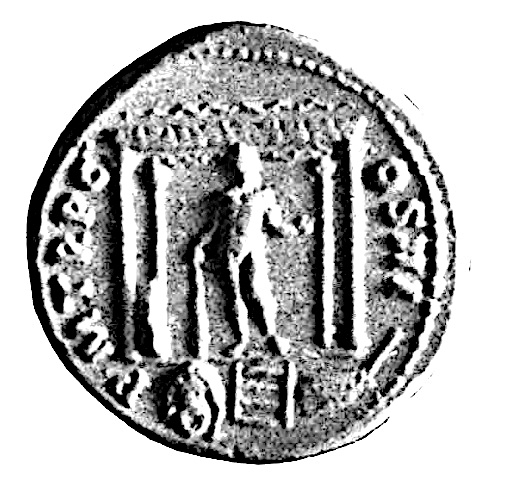
Fabio Barry, in "The mouth of truth and the Forum Boarium: Oceanus, Hercules, and Hadrian, The Art Bulletin, March 2011, Volume XCIII, Number 1" draws an important connection between Hercules, Oceanus, and the Emperor Hadrian, who, according to him, had the Mouth of Truth placed at the feet of Hercules in a temple dedicated to him or in the Ara Maxima. Barry writes: "Some versions of the legends of Hercules tell us that his expeditions against Geryon and in the Garden of the Hesperides took him across the Ocean. His starting point has been identified with Cadiz, which he himself founded, near the famous columns, and here, facing the Atlantic Ocean, stood the most important sanctuary of this traveling Hercules. The sanctuary had been founded by the Phoenicians for the merchant god Melqart, with whom Hercules had been identified as early as the 7th century BC, and the temple retained its Phoenician appearance until the late Roman era." Barry suggests that Hadrian, like Hercules, was a great traveler, who uniquely dedicated a temple to Oceanus in the British Isles: "In Newcastle, beside the Pons Aelius, which the emperor ordered to be built over the River Tyne (122 AD), we find the only Roman altar known to be dedicated to Oceanus, a deliberate echo of the only other altar known to have been dedicated to Oceanus, the one Alexander the Great dedicated to him on an island at the mouth of the River Indus." And again "only one emperor - Hadrian - minted coins depicting Hercules and Oceanus together, and also an Aureus (the coin of highest value, almost pure gold) in no less than 5 versions. The simplest show us Hercules standing and Oceanus bowing. The others show us Hercules in a tetrastyle aedicule, either alone or among the hesperides, but always with Oceanus at his feet. Most important for our purpose is one version, which depicts Oceanus in the same disembodied configuration that is represented by the Mouth of Truth".
Where was the Mouth of Truth?
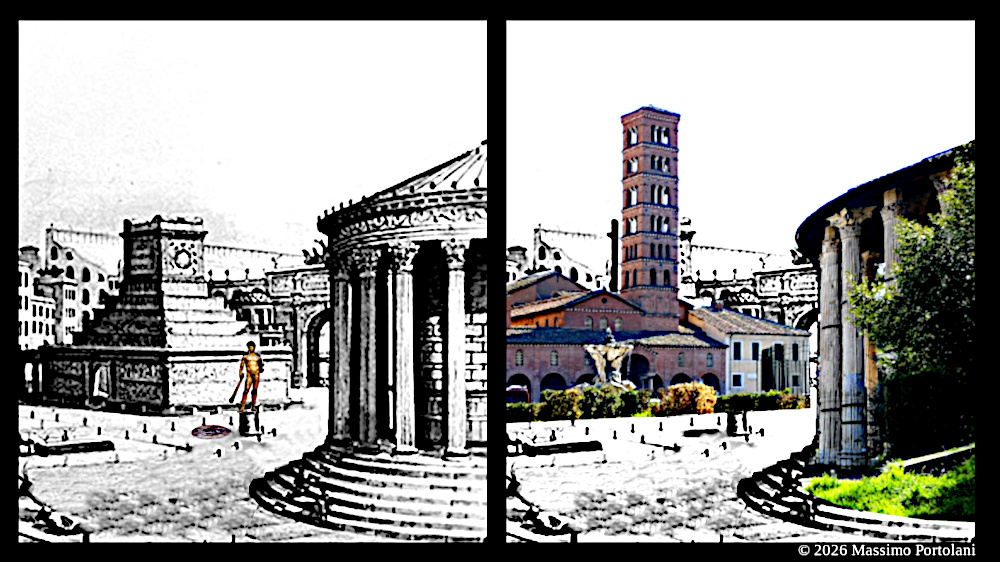
I agree with Fabio Barry and think that the Mouth of Truth covered a water collection point placed on a flat surface beneath a statue of Hercules, symbolizing the conquest of the Ocean by the traveling hero. Perhaps it was located inside the Ara Maxima, and was placed there in 782 when the Altar was destroyed. Or it was inside the round temple of Hercules Victor, right in its center, to collect the little rainwater that could enter from the oculus (the central upper opening, as in the Patheon). Or it could have been directly in front of a statue of Hercules seen in the Forum Boarium in a 19th-century drawing that attempts to reconstruct the Forum Boarium in Roman times. I tried to superimpose this print with a photo I took in the area, from the same angle. You can see the round temple of Hercules Victor, which is still in the same place (because it had been transformed into a Christian church), and you can see the Basilica of Santa Maria in Cosmedin, which stands approximately on the site of the Ara Maxima.
Learn more
If you're interested in learning more about the Mouth of Truth and the legends that have been created and told about it, you can read my book. Massimo Portolani, La Bocca della Verità, nascita di una leggenda soon to be available on Amazon.
Machines type Mouth of Truth manufactured by DPS-Promatic srl'
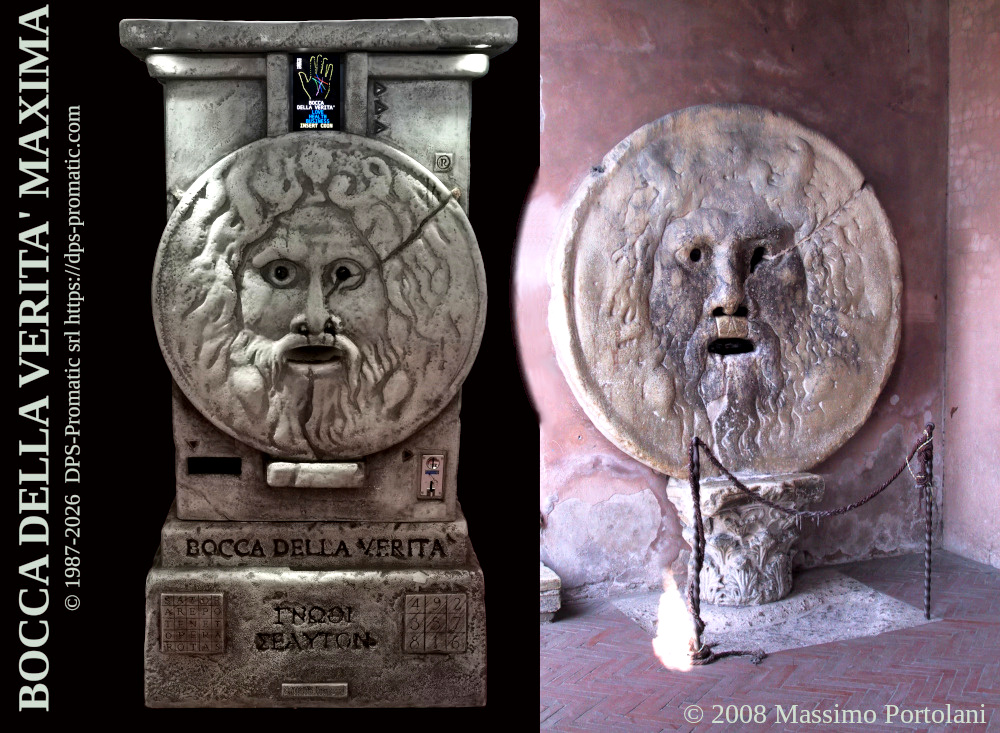
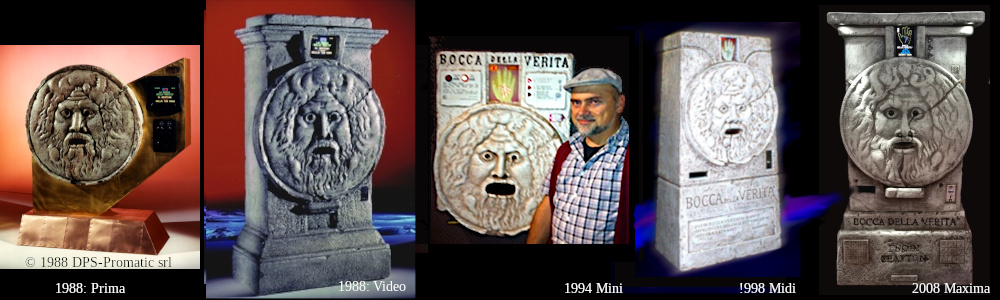
In 1987, we installed the first Mouth of Truth kiosk in Rome's Luneur Park. In 1988, we presented the prototype Bocca della Verità at the Milan Fair. This coin-operated display was entirely covered in copper and brass foil. Then we began production of the Bocca della Verità Video, and in 1994, we began production of the Mini Bocca, which hung on the wall or in photo booths. We continued with the Midi, starting in 1988, and finally, in 2008, with the Maxima, a model that we still sell today, representing the right balance between visual impact and size.
Bocca della Verita Maxima
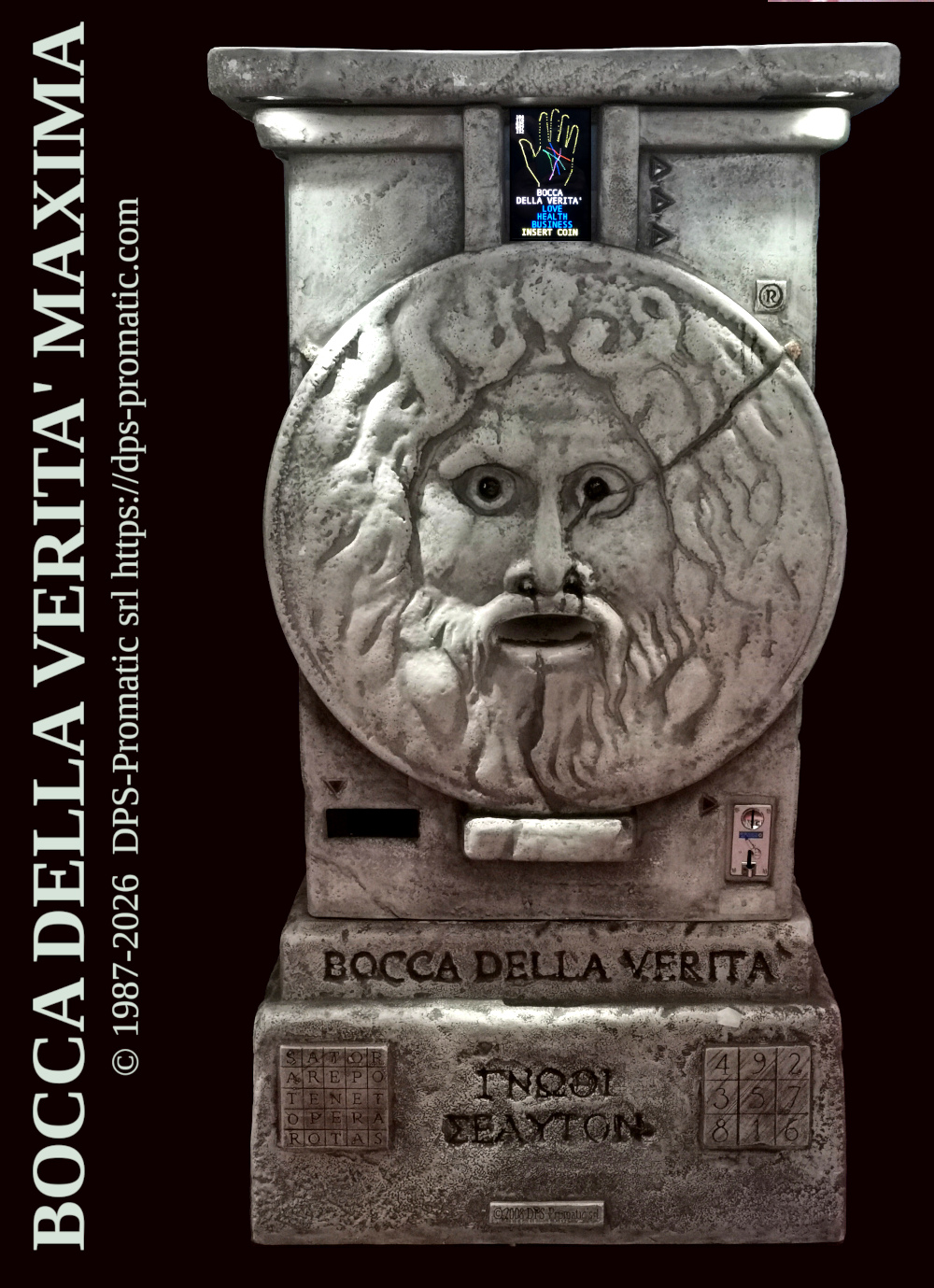
The Bocca della Verita Maxima has been in production since 2008, albeit with electronics changes, to keep pace with technology. The last electronics update was made in 2024, and we sell conversion kits for any machine we've produced from 1987 to today..
Ecco aluni esempi di stampa di questa macchina (nel tempo il formato potrebbe essere cambiato):
Here are some videos related to the Mouth of Truth: